 DanFin
Survivorship Bias in Trading: Why Your Feed Is Full of Winners
In short
- Around 90% of traders lose money, yet your feed is full of people who got rich trading. Those two facts do not contradict. They are the same thing: survivorship bias.
- Survivorship bias is when you only see the winners and never the far larger group that failed and went quiet, so you overrate the odds and mistake luck for skill.
- A simple coin-flip experiment shows how pure chance alone can turn 1,000 traders into 62 "geniuses" in four rounds. Those 62 are the ones selling you a course.
- The fix is to stop trusting screenshots and start demanding evidence: a clear hypothesis, fixed rules, a proper backtest, a stress test, and diversification.
- For prop firm traders, you can turn that uncertainty into a number. Use the free simulator to estimate your real odds of passing before you pay.
Roughly 90% of retail traders lose money. You have probably seen that statistic before. And yet, if you open TikTok or Instagram, your feed is full of people who apparently made a fortune trading, flashing profit screenshots, rented cars, and a course that will teach you their secret.
Those two facts feel like a contradiction. They are not. They are the same phenomenon seen from two angles, and understanding it is one of the most useful things a new trader can learn. It is called survivorship bias, and once you see it, you cannot unsee it.
Claim your spot on the waitlist
I am releasing one of my trading strategies shortly. Join the waitlist and receive a discount at launch.
Claim your spot →What is survivorship bias?
Survivorship bias is a thinking error where you judge a situation by looking only at the people or things that "survived" a process, while the ones that failed are invisible because they dropped out and went silent. Because the failures are missing from view, you badly overestimate the odds of success and start crediting skill where there was mostly luck.
The classic example comes from the Second World War. Engineers studied bombers returning from missions and found the bullet holes were concentrated on the wings and tail. The obvious response was to add armour where the holes were. The statistician Abraham Wald pointed out the mistake: those were the planes that came back. The planes hit in other places, like the engines, were not in the sample, because they never made it home. The armour belonged where the returning planes were not hit. The data only showed the survivors, and reading it at face value pointed exactly the wrong way.
Trading is full of the same trap. The winners are loud and visible. The losers quietly close their accounts and say nothing. So the picture you see is not reality, it is only the survivors.
A coin-flip game that manufactures "geniuses"
Here is a thought experiment that makes it concrete. Imagine 1,000 people each start with 1,000 dollars. To keep it simple, trading is a pure coin flip: each round you either double your money or lose it all, a clean 50/50, with no skill involved at all.
Round one: 500 people double their money, 500 lose everything and quit. Round two: of the survivors, 250 double again. Round three: 125 double again. Round four: about 62 people are left, and each has turned 1,000 dollars into 16,000 dollars.
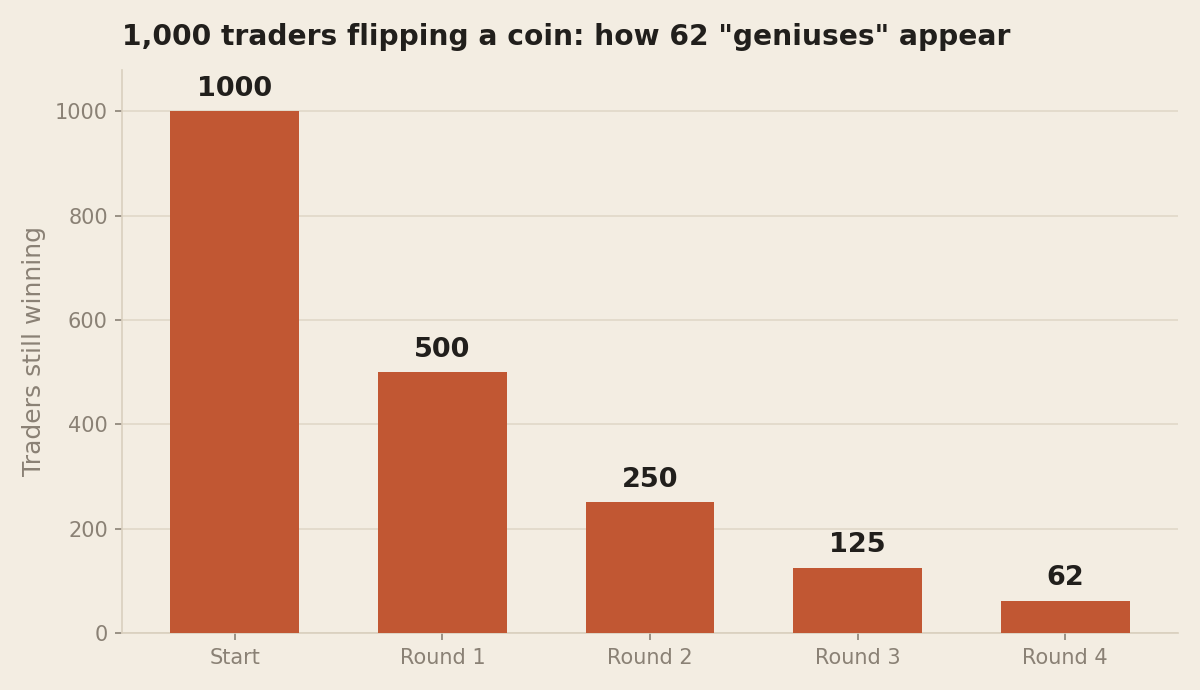
Those 62 people look like geniuses. They have quadrupled, then multiplied their money sixteen times over. But nobody in this game had any skill. It was a coin flip from start to finish. The number of survivors is simply the group halved four times: 1,000, then 500, 250, 125, and about 62. Luck alone guarantees that some people win big, purely because you started with enough players.
What your feed actually shows you
Now look at what those 62 winners do next. They post the screenshots of profit. They photograph the expensive car. They launch a course: "How I turned 1,000 dollars into 16,000 in a month." Their story is genuinely true, they really did make that money, which is exactly what makes it so convincing.
Meanwhile the 938 people who lost everything are not posting. They are not filming content or selling courses, and they are certainly not on your feed. They are invisible, just like the bombers that never returned. So the only version of trading you ever see is the one told by the tiny minority who happened to win.
You are not seeing the best traders. You are seeing the luckiest ones, because the unlucky ones went quiet.
Why this matters: luck disguised as skill
In the real world, one of those 62 lucky winners becomes your "mentor," surrounded by a handful of followers who got lucky in the same way, selling a strategy that was never actually profitable. You, and often they, are all mistaking luck for skill. That is the heart of the problem, and it plays out in a few predictable ways.
A payout screenshot is not proof of an edge. It proves that one person, on one run, ended up ahead. In a big enough crowd, that is guaranteed to happen to someone by chance. It tells you nothing about whether the method actually works over the long run.
Even a real edge tends to fade. If a strategy genuinely worked and then got sold to thousands of followers, it stops being secret, and edges that everyone trades get competed away. A method still worth keeping would usually be worth more kept private than sold as a course.
The incentives are not yours. Most of these figures earn their money from courses, signals, and subscriptions, not from trading. A follower who becomes genuinely self-sufficient stops paying. So the business depends on a steady stream of hopeful newcomers, not on making anyone independent.
None of this means trading cannot work. It means a confident person with a Ferrari and a screenshot is not evidence of anything, and your own testing matters far more than their highlight reel.
How to tell luck from skill
The antidote to survivorship bias is evidence over anecdote. One winning run, yours or a mentor's, is a single data point, and single data points are mostly noise. To separate a real edge from a lucky streak, you need a large enough sample and a repeatable process. In practice that means five steps.
- Make a hypothesis. State clearly what you think gives you an edge and why, so it can actually be tested rather than felt.
- Write clear rules. Turn the idea into exact entry, exit, and risk rules. If it cannot be written down, it cannot be tested, and it cannot be repeated.
- Backtest it. Run the rules over a long stretch of history, at least a year, and split the data: build on one part, then test the untouched part. If it only works on the data you tuned it on, the edge was imaginary.
- Stress test it. A single backtest is one path through the past. Reorder or resample the trades and the outcome can look very different. A Monte Carlo simulation runs thousands of variations to show the range of outcomes, not one lucky curve.
- Diversify. Spreading risk across uncorrelated markets and setups smooths results and stops a single bad streak from wiping you out, which is also how you avoid becoming one of the silent 938.
This is how you turn a fallacy into statistics and confidence. Instead of trusting a story, you build a process that would expose a weak strategy before it costs you real money.
Turning uncertainty into a number
If you trade prop firm challenges, there is a direct way to apply all of this. Passing a challenge is a barrier problem: you have to reach a profit target before hitting a drawdown, over a fairly short run of trades. That is exactly the kind of question a Monte Carlo simulation is built to answer.
Once you have backtested your strategy and know your win rate, your reward-to-risk, your trades per day, and your risk per trade, you can stop guessing. The free simulator on this site takes those numbers and estimates your real probability of passing, and it compares more than 20 prop firms to show which evaluation best fits how you actually trade. It is the difference between hoping you are one of the 62 and knowing your actual odds before you pay a fee.
Stop guessing, start simulating
Enter your win rate, reward-to-risk and risk per trade, and the free simulator shows your real odds of passing each firm's challenge. No screenshots, just the maths.
Open the simulator →Compare prop firms side by side on rules, payouts and reviews, and find their current discounts.
Compare firms and get discounts →Summary
- Survivorship bias means you only see the winners, so you overrate the odds and mistake luck for skill.
- 90% of traders losing while your feed is full of winners is not a contradiction, it is the same effect: the losers go silent.
- You only ever see the lucky ones. The winners appear on your feed, while the far larger group who lost quietly disappears.
- A payout screenshot proves someone got lucky, not that a strategy has an edge.
- Beat the bias with process: hypothesis, rules, backtest, stress test, diversify, and run your real odds before you pay.